OpenAI kills Sora: the first satisfying AI failure
 By Andy Webb
 Every image in this article was generated by Sora. Consider it a farewell performance.
Sora is dead.
On 24 March, OpenAI confirmed it's shutting down the entire platform: the app, the API, Sora.com, all of it. The Sora 2 model technically survives tucked behind the ChatGPT paywall, but the product itself, the social media app that was supposed to be the future of video, the platform that had Disney writing billion-dollar cheques? Gone. Six months from the most hyped AI product launch of 2025 to a farewell post on X.
And honestly? This might be the most clarifying thing to happen in the AI tools space all year. Not because a product failed, products fail all the time, but because of what this particular failure tells us about which AI tools are real and which are theatre.
The rise was spectacular

When Sora launched as a standalone app last September, it immediately went viral. It smashed 3.3 million downloads in its first two months. It was the most-downloaded app in the App Store's Photo and Video category... on launch day! The AI industry patted itself on the back. It had found a new darling to terrify the incredible actors, actresses, and production staff that have been bringing the arts to the screen for the last 100 years. Investment poured in and one of humanity's greatest gifts to the world, the Arts itself, was suddenly at a precipice.
The videos were undeniably impressive. Type a prompt, wait a few seconds, and out came footage that would have taken a small production team days to shoot. People made Mario smoking weed. Pikachu doing ASMR. Martin Luther King Jr. doing things his daughter had to publicly beg users to stop creating. The guardrails were a joke, but the technology was real, and that combination of power and recklessness made Sora the most talked-about app in tech.
Disney, never one to miss a bandwagon, signed a three-year licensing deal in December. Over 200 characters from Disney, Marvel, Pixar, and Star Wars were going to be available for AI-generated video. Mickey Mouse, reimagined by anyone with a $20 subscription and an idea. Disney also committed to a $1 billion investment in OpenAI, paid in stock warrants. The future of entertainment, we were told, was generative.
The fall was faster
Then the numbers stopped cooperating.
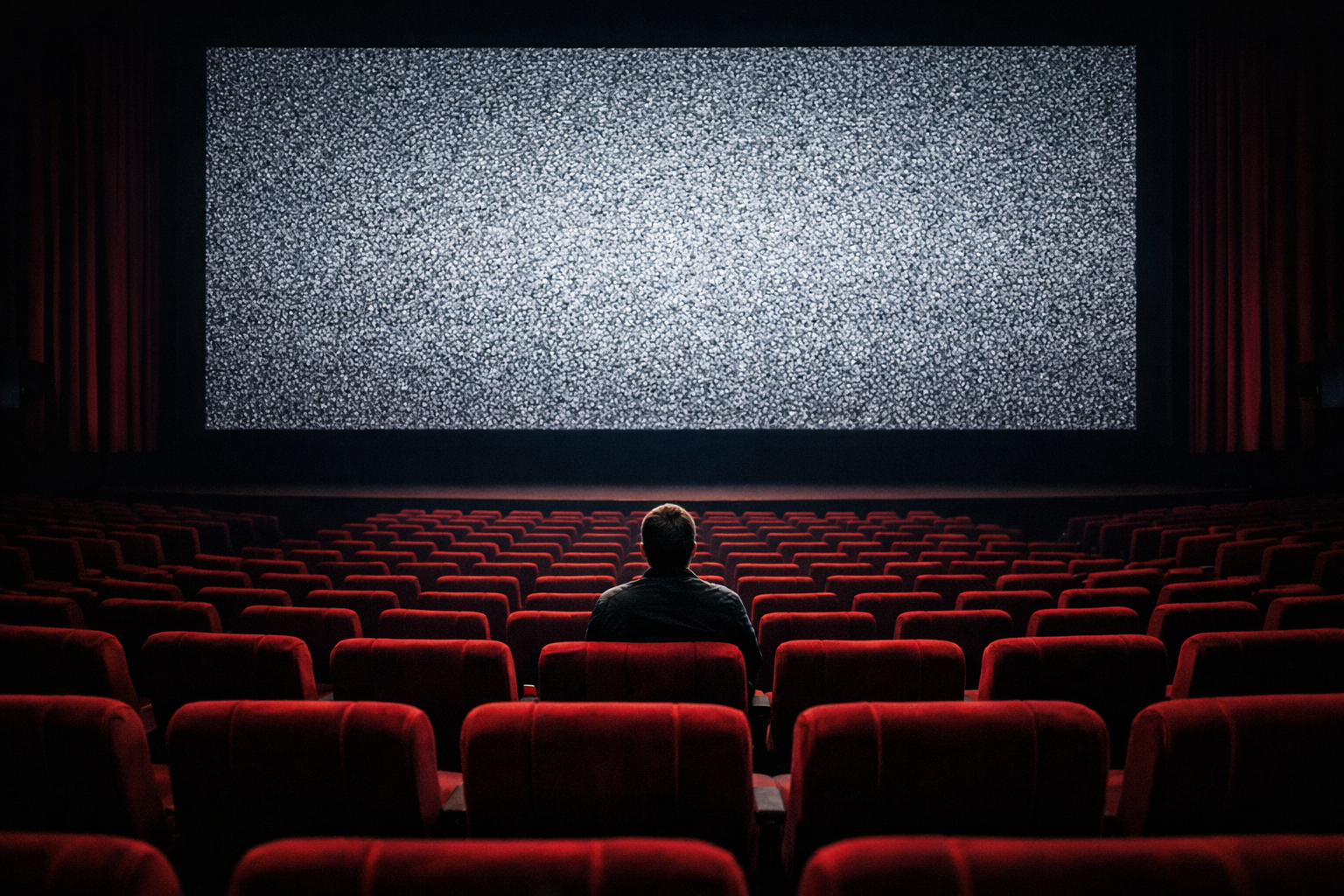
By February 2026, monthly downloads had cratered to 1.1 million.
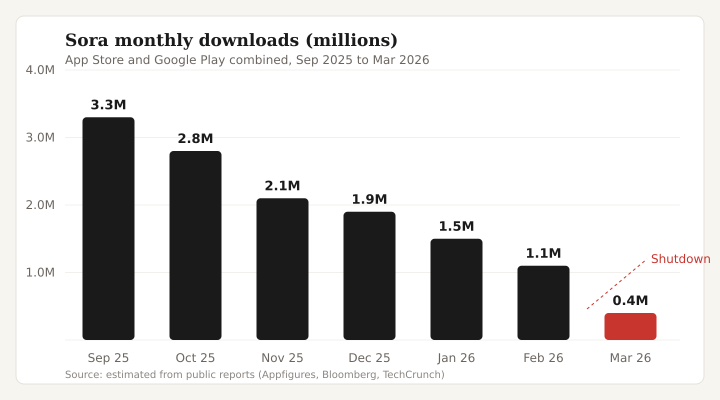
That sounds like a lot until you remember that ChatGPT has 900 million weekly active users. Sora wasn't growing. It was collapsing. Total revenue from in-app purchases across its entire existence? Roughly $2.1 million. For a company valued at $730 billion, that's not a rounding error. It's a rounding error's rounding error.
The thing about AI video generation that nobody in the hype cycle wanted to acknowledge is that it's absurdly expensive to run. We're talking roughly 100 times the compute cost of image generation. Every video Sora produced was burning through GPU capacity that could have been running thousands of ChatGPT conversations or processing hundreds of API calls from paying enterprise customers. In a world where OpenAI is haemorrhaging cash and preparing for an IPO, keeping Sora alive wasn't just unprofitable. It was indefensible.
What's the collateral damage

The collateral damage makes this even more striking, especially coming off the back of a brutal few months for OpenAI after the White House bun fight with Anthropic that saw users leave in their tens of thousands to OpenAI's largest competitor. Disney had signed a three-year deal with OpenAI to license 200+ characters from Disney, Marvel, Pixar, and Star Wars for use on Sora. They'd planned a $1 billion investment in OpenAI tied to the partnership. All of that is now being unwound and the once sullen arts community is rejoicing in their downfall. A billion-dollar deal, killed because the underlying product couldn't justify its own electricity bill. And there's an idea for another article...
The actors' unions that had been sounding alarms since Sora's launch are, understandably, feeling vindicated. The deepfake concerns were real, the copyright implications were enormous, and the entire project carried a faint whiff of Silicon Valley's least attractive quality: the assumption that disruption is inherently good, even when what you're disrupting is the livelihoods of hundreds of thousands of creative professionals.
Here's what nobody else is saying
Every outlet is covering this as a product shutdown. TechCrunch, Bloomberg, Variety, NPR, they're all reporting the facts. What nobody is willing to say plainly is this: Sora was never really a product. It was a demo that got out of hand.
Think about it. OpenAI first showed Sora to the world in February 2024 with a series of stunning generated videos. The internet lost its collective mind. The hype was immense, the fear was palpable, and the message was clear: look what AI can do now. That was the point. Sora was designed to generate headlines, not revenue. It was a proof of concept that got dressed up as a consumer product because the AI arms race rewards spectacle. Every lab needs a "look what we can do" moment to attract funding, talent, and press coverage. Sora was OpenAI's, and it worked brilliantly as marketing.
The problem is that someone then had to actually run it as a business. And when you're spending orders of magnitude more on compute than you're earning from users, the maths doesn't care how impressive your demos are. The IPO is coming. The investors want numbers. The GPUs need to go where the money is.
The Anthropic contrast
Now look at what Anthropic did during the same period. This is the bit that should really make you think.
While OpenAI was pouring resources into image generation, video generation, a social media app, a Disney partnership, and a shopping feature inside ChatGPT, Anthropic did none of that. Zero. They built text models. They built coding tools. They built agentic infrastructure. They said no to everything that wasn't directly useful for professional work.
The result speaks volumes. Claude is now the number one AI app in the United States, boosted in part by the #QuitGPT movement that saw millions of users abandon ChatGPT over OpenAI's controversial Department of Defence deal. Anthropic's revenue is growing faster than OpenAI's on a percentage basis. The company that said "no" to the flashy stuff, that refused to build the dazzling demo, is winning.
There's a lesson here that extends well beyond these two companies, and it's one we think about constantly when reviewing AI tools. The products that endure are the ones that solve a problem you can measure. Code that ships faster. Analysis that saves hours. Workflows that run without you. Not tools that generate an impressive clip you share on X once and then never open again.
What this means if you're choosing AI tools right now
If you're evaluating AI tools for your work or your team, Sora's failure gives you a genuinely useful filter. Ask yourself: does this tool generate value I can measure, or does it generate content I can share?
The first category, code assistants, AI writing tools, workflow automation, data analysis, has proven economics. Companies pay for these because they deliver a return. Cursor saves developers hours every week. Claude helps teams analyse documents in minutes instead of days. n8n automates workflows that used to require a full-time employee. These tools pay for themselves and then some.
The second category, AI video, AI music, AI image generation as standalone products, is still searching for a model that works. That doesn't mean the tools are useless or that the technology isn't remarkable. It means that building critical workflows around them carries real platform risk. If OpenAI, with $730 billion in valuation and $110 billion in fresh funding, couldn't make AI video generation economically viable, what does that tell you about the smaller players?
Our advice is simple: diversify. Don't anchor your creative process to any single AI media platform until the category has proven it can sustain itself. The tools generating text, code, and structured data are on solid ground. Everything else is still a bet, and this week we learned that even the biggest player at the table can fold.
What we're watching next
The AI video market isn't dead. Runway, Google's Veo, Kling, and several others continue to operate. But they're all facing the same fundamental economics that killed Sora. Compute costs need to come down dramatically, or business models need to change radically, for standalone AI video generation to work as a sustainable business.
We suspect AI music generation faces the same reckoning, and possibly sooner. Similar compute demands. An even more aggressive copyright landscape. Record labels that make Disney look friendly. And no clear path to the kind of revenue that justifies the infrastructure.
The AI tools that will define 2026 won't be the ones that generate the most impressive demos. They'll be the ones that are still running in 2027. We'll be watching closely, and telling you which ones are which.

The sharpest AI tools intel, weekly.
Join thousands of professionals navigating the AI tools landscape. Free, no spam, unsubscribe anytime.