ChatGPT vs Claude vs Gemini: we picked a winner and we're not sorry
 By Andy Webb
Claude. That's the answer. If you've got $20 and you need one AI assistant for professional work, spend it on Claude Pro. ChatGPT is the most feature-packed. Gemini is the one you tolerate if Google owns your soul. But Claude is the one that makes you better at your job.
That will upset people. Some of you are already composing angry replies. Good. If you wanted a diplomatic "it depends on your needs" non-answer, there are 300 other comparison articles waiting for you. We use all three of these tools every single day and we have opinions. Strong ones. Ones we've earned by actually building things with them, not by running benchmark scripts and copy-pasting the results into a table.
We built The Bot Market, the site you're reading right now, with Claude. Not because we set out to prove a point, but because every time we sat down to do the real work, the thinking and writing and building, we kept reaching for the same tool. That tells you more than any leaderboard score ever could.
ChatGPT Plus Visit ChatGPT Plus | Claude Pro Visit Claude Pro | Gemini Advanced Visit Gemini Advanced | |
|---|---|---|---|
| Core | |||
| Price | $20/month | $20/month | $19.99/month |
| Latest model | GPT-5.4 | Claude Opus 4.6 | Gemini 3.1 Pro |
| Context window | 128K-1M tokens | 200K-1M tokens | 1M tokens |
| Free tier | Yes (with ads) | Yes | Yes |
| Strengths | |||
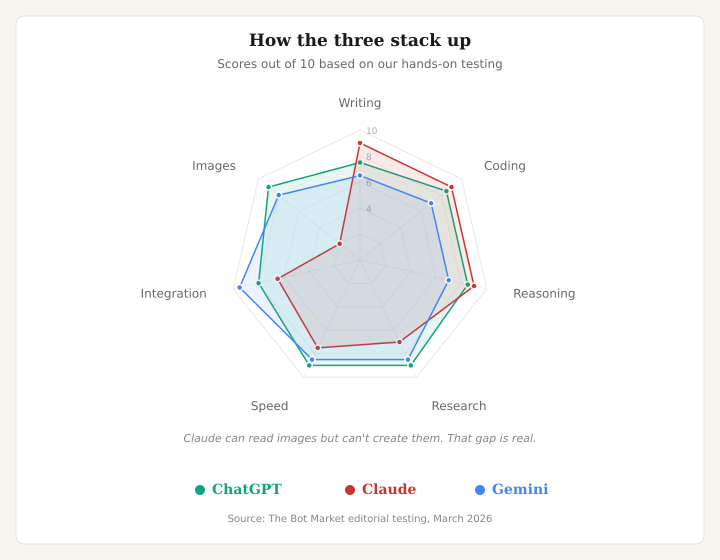
| Writing quality | Good | Excellent | Decent |
| Coding | Excellent | Excellent | Good |
| Reasoning | Excellent | Excellent | Good |
| Research | Excellent | Good | Excellent |
| Image generation | Yes (DALL-E) | No | Yes (Imagen) |
| Ecosystem integration | Moderate | Growing | Deep (Google) |
| Try ChatGPT Plus | Try Claude Pro | Try Gemini Advanced | |
Where they actually diverge
Every comparison piece leads with benchmark scores. MMLU this, SWE-bench that. We're skipping all of it. The benchmarks are nearly identical at the top end and they tell you precisely nothing about what it feels like to use these tools for work that matters. Instead, here are the three areas where they genuinely pull apart.
Claude reads the room
You notice this within the first hour of switching from ChatGPT to Claude, and once you've felt it, you can't unfeel it. Claude reads your entire prompt before responding. It follows complex, multi-part instructions without dropping constraints halfway through. It maintains consistency across long documents in a way that ChatGPT, for all its tricks, simply doesn't manage.
We've been using Claude as our primary AI for months. Not because of some brand loyalty to Anthropic (although, full disclosure, Claude is quite literally the AI behind the conversation that shaped this article), but because when we tested all three for sustained, structured work, Claude produced output that needed the least fixing afterward. That's the metric that actually matters when you're building something real: how much time do you spend cleaning up what the AI hands you?
ChatGPT drifts. Ask anyone who's used it for long tasks. You set up careful constraints in your system prompt, craft your instructions with precision, and by message fifteen it's forgotten half of them and is freewheeling like a jazz musician who's lost the sheet music. Claude treats your instructions like a contract. It remembers them. It follows them. It even pushes back if you ask it to do something that contradicts what you told it earlier. That's not annoying. That's exactly what you want from a tool you're trusting with professional work.
ChatGPT has the biggest toolbox (and it matters)
If Claude wins on quality, ChatGPT wins on sheer breadth. And the gap is not small.
ChatGPT generates images with DALL-E. It browses the web with citations. It has a code interpreter that actually runs Python and shows you the results. It has Deep Research mode for thorough analysis. It integrates with 60+ apps including Slack, Google Drive, GitHub, and Atlassian. It lets you build custom GPTs, specialised assistants tuned to specific tasks. And since March 2026, GPT-5.4 is genuinely impressive for multi-step reasoning.
Claude offers none of that in the consumer product. No image generation. No app marketplace. No code execution. What Claude has is Projects (persistent context across conversations), a growing set of MCP integrations, and the best coding assistance available through Cursor and Claude Code. But if you need a single tool that writes your report, generates the header image, analyses your spreadsheet, and researches your competitors, all before lunch, ChatGPT is the more complete package and it's not particularly close.
Put bluntly: ChatGPT does more things. Claude does the important things better. Which one of those sentences matters more to you will determine which $20 you should spend.
Gemini is playing an entirely different sport
Gemini's advantage has nothing to do with how clever the model is and everything to do with where your files already live. If your company runs on Google Workspace, Gemini sits inside your Docs, Sheets, Slides, Gmail, and Drive. It can reference your calendar, search your email, and pull context from documents you wrote six months ago without you copying and pasting a thing. That's not trivial. For large organisations already deep in the Google ecosystem, it removes an entire layer of friction.
The 1 million token context window is the real headline here. Legal teams reviewing stacks of contracts. Analysts chewing through quarterly earnings reports. Researchers scanning dozens of papers. For raw document ingestion at scale, Gemini has a genuine edge that neither ChatGPT nor Claude can match today.
But (and you knew this was coming) the output quality is the weakest of the three for anything creative or analytical. Gemini hallucinates more freely than Claude. It can be oddly inconsistent, giving different answers to the same question if you ask it twice. And there's a peculiar cognitive friction that's hard to describe until you've experienced it: Gemini constantly toggles between being a helpful assistant and being a search engine, and the transitions are jarring enough to break your train of thought. ChatGPT and Claude feel like talking to a person. Gemini feels like talking to a very clever toolbar.
Google is improving. Gemini 3.1 Pro is a genuine step forward. But in March 2026, judged purely on the quality of the thinking that comes back when you hit send, Gemini finishes third.
The feature nobody talks about enough
Claude's Projects feature is quietly the most important development in AI assistants this year. You create a persistent workspace with custom instructions, reference documents, and shared conversation history. Every time you open a new chat within a Project, the AI already knows your context, your preferences, your terminology, and your quirks.
We have a Bot Market project where Claude knows our style guide, our content calendar, our tech stack, and the editorial voice we've spent weeks developing. When we ask it for an article draft, it doesn't produce generic AI slop. It produces something that sounds like us. Because it has the context to do so, built up over dozens of conversations.
ChatGPT has custom GPTs, which aim for something similar, but they're rigid by comparison and lack the conversational memory. Gemini has nothing in this category at all.
For anyone doing sustained professional work with an AI, the ability to build up context over time is the feature. Not image generation. Not web browsing. Not a fancier model. Context. And right now, Claude does it best by a country mile.
Pricing: they're all twenty quid
Easiest section we've ever written:
| Plan | Price | What tips the scales |
|---|---|---|
| ChatGPT Plus | $20/month | DALL-E, code interpreter, Deep Research, 60+ app integrations |
| Claude Pro | $20/month | Projects, extended thinking, Claude Code access |
| Gemini Advanced | $19.99/month | Google Workspace integration, 1M token context, 2TB Google One storage |
ChatGPT also has a Go plan at $8/month, but it includes ads and strips out the features that make Plus worth having. A bit like ordering a sports car and being told the engine costs extra. Gemini bundles 2TB of Google One storage, which is a genuine perk if you use Google Drive. Claude's Max plans at $100 and $200/month unlock higher limits and Claude Code guest passes for the truly committed.
At the $20 tier, price isn't a factor. This decision comes down to which tool fits how you actually work.
OpenAI put ads in ChatGPT (and we need to talk about it)
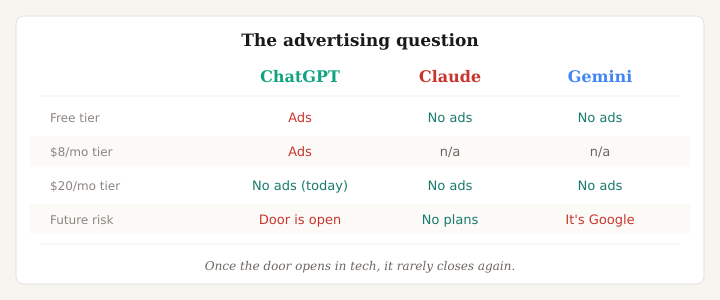
In February 2026, OpenAI introduced advertising to ChatGPT's Free and Go tiers. The $8/month Go plan, the one positioned as the affordable alternative to Plus, still shows ads. You read that correctly. Eight dollars a month. Ads in your AI assistant.
OpenAI maintains the ads are "clearly labelled" and don't influence responses. Perhaps. But the principle matters more than the current implementation. Today it's the free and budget tiers. What happens when the IPO investors want more revenue and someone suggests "sponsored suggestions" in Plus? We're not predicting it. We're pointing out that the door is now open, and once that door opens in tech, it rarely closes again.
Claude has no ads. Anthropic has stated no plans to introduce them. Gemini has no ads in the Advanced tier, though Google's entire business model is literally built on advertising, so make of that what you will.
If you're choosing a platform to build your professional workflow around for the next two years, the advertising question deserves more weight than most comparison articles give it.
Who should use what
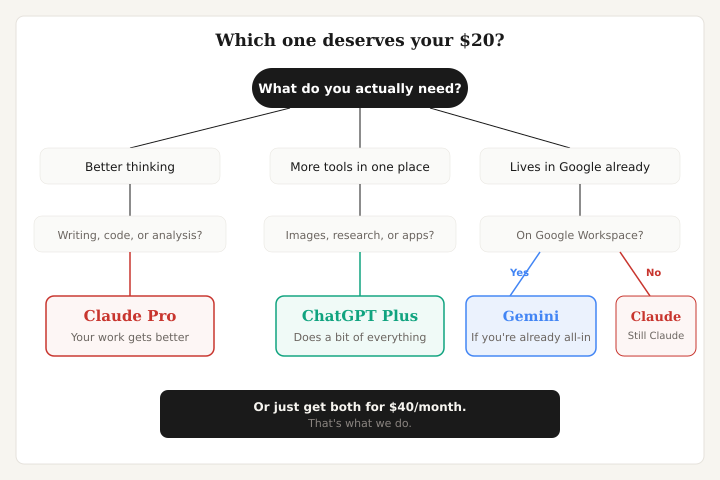
Choose Claude if you write, analyse, code, or do any sustained thinking where the quality of what comes back matters more than how many party tricks the tool can perform. If you build with Cursor or Claude Code, stop reading and go subscribe. The entire ecosystem connects. If you value a tool that follows your instructions to the letter and doesn't wander off mid-conversation like a distracted spaniel, Claude is the one.
Choose ChatGPT if you need the Swiss Army knife. Image generation, spreadsheet analysis, code execution, web research, custom assistants, all in one place. If your work is varied and you touch six different kinds of task before noon, ChatGPT's breadth is unmatched. Just know that you're trading depth for width, and that trade-off shows up when the work gets serious.
Choose Gemini if your organisation already runs on Google Workspace and the constant friction of copying data between apps is your biggest time sink. Gemini's integration advantage is real, but only if you're already in the ecosystem. Switching to Google Workspace specifically to access Gemini would be like buying a house because you liked the doorbell.
The power move is to run two of them. We use Claude for writing, analysis, and coding, and ChatGPT when we need its tool integrations or image generation. That's $40/month for the best of both worlds. If the budget stretches, this is what we'd recommend without hesitation.
Our recommendation
Claude Pro. $20/month. For most professionals reading this site, it's the right call.
The writing is measurably better. The instruction-following is more reliable. Projects give you persistent context that compounds in value the longer you use it, like a colleague who actually remembers what you discussed last week. The ecosystem is growing at speed: Cursor uses Claude, Claude Code is the best terminal coding agent available, and the #QuitGPT movement saw millions of developers switch over the past few months. They're not switching back.
ChatGPT is a close second and a better fit for specific workflows. We're not dismissing it. We use it every day. But when we sit down to do the work that matters most, the thinking and writing and building that actually moves things forward, we open Claude.
Six months ago, this would have been a much tighter call. Today, with Opus 4.6, the Projects feature, and the momentum behind the platform, the gap between first and second has widened enough that we're comfortable picking a side.
Spend your $20 on Claude. Use ChatGPT's free tier for the things Claude can't do. Keep one eye on Gemini, because Google has the resources and the motivation to close the gap faster than most people expect. And if someone tells you "it depends on your needs" without specifying what those needs actually are, find a better source.
You just did.
The sharpest AI tools intel, weekly.
Join thousands of professionals navigating the AI tools landscape. Free, no spam, unsubscribe anytime.